

by Oscar and Jackson
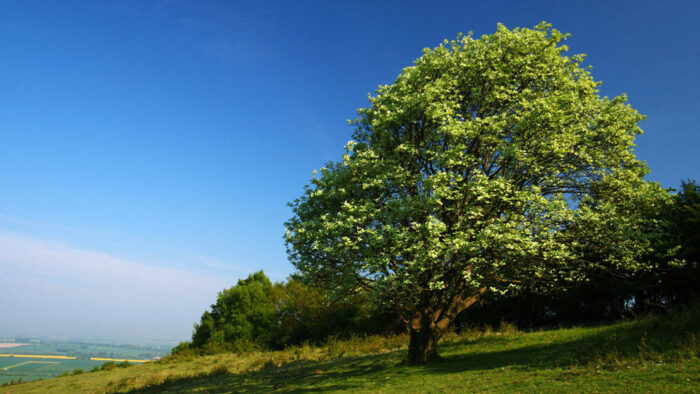
Charming and domestic, the whitebeam’s fruit is a favourite of garden birds. It’s rarely found in the wild but is a popular ornamental tree in parks and gardens, with lovely blossom and russet autumn leaves.
Quick facts
Common names: common whitebeam
Scientific name: Sorbus aria
Family: Rosaceae
Origin: native
Whitebeam is a deciduous broadleaf tree that is compact and domed. Mature trees can grow to a height of 20m. The bark and twigs are smooth and grey and the shoots are brick red in sunlight but greyish-green in shade.
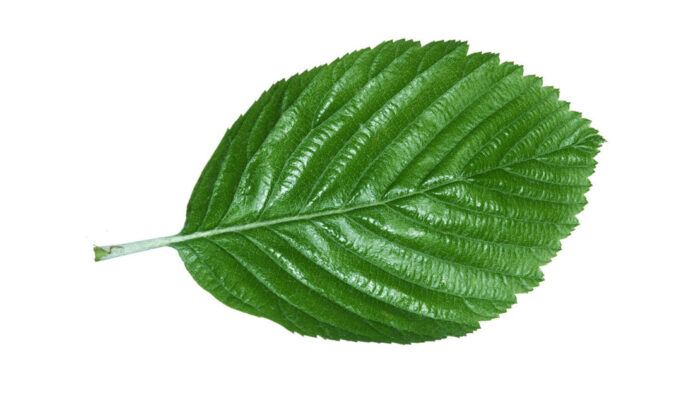
Look out for: the oval, serrated-edged leaves that are softly hairy underneath and dark green and shiny on top.
Identified in winter by: the young twigs which start hairy and become smooth later. Only the edges of the buds are hairy.
What does whitebeam look like?
Leaves
Leaf buds are green and pointed and leaf stalks are short. Leaves are thick, oval and irregularly toothed, with the underneath covered in white, felt-like hair. When the leaves first unfold, they look like magnolia flowers. They fade to a rich russet colour before falling in autumn.
Flowers
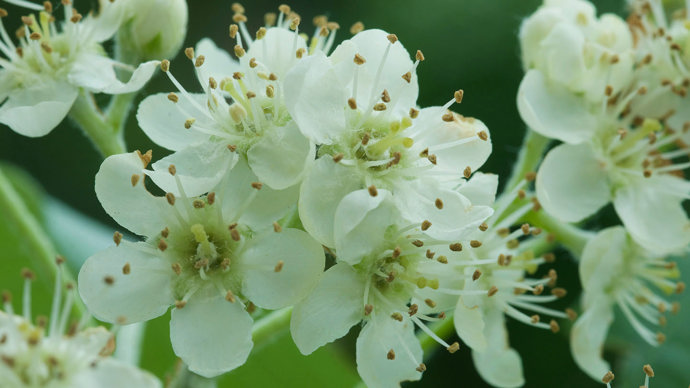
Whitebeam is hermaphrodite, meaning each flower contains both male and female reproductive parts. The five-petalled flowers appear in clusters in May, and are pollinated by insects.
Fruits
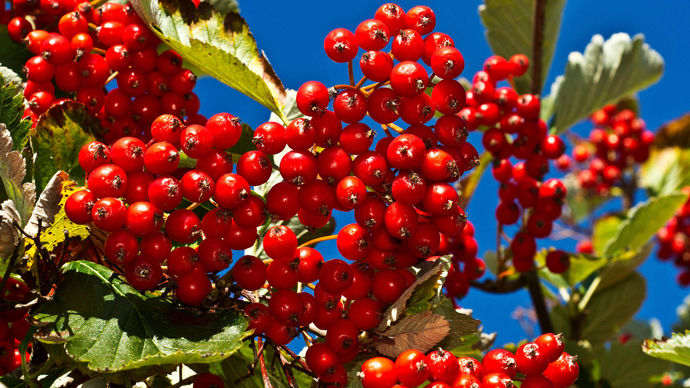
Flowers develop into scarlet berries, which ripen in late summer or autumn.
Value to wildlife
The flowers are pollinated by insects and the berries are favoured by birds. The leaves are eaten by caterpillars of a number of moths.